> For the complete documentation index, see [llms.txt](https://docs.net2grid.com/llms.txt). Markdown versions of documentation pages are available by appending `.md` to page URLs; this page is available as [Markdown](https://docs.net2grid.com/net2grid-energy-ai-cloud/overview/how-energyai-cloud-works.md).
# How NET2GRID EnergyAI® Cloud works
NET2GRID EnergyAI® Cloud combines a secure, scalable cloud environment with a purpose-built intelligence engine to turn raw smart meter data into detailed energy insights. Here is a look under the hood at both halves of the service: the cloud it runs on, and the AI engine that powers it.
***
## Cloud
### Hosted on AWS
NET2GRID EnergyAI® Cloud runs on Amazon Web Services (AWS) infrastructure, hosted and managed by NET2GRID. This cloud-native foundation provides the scalability, reliability, and security needed to process smart meter data for millions of households worldwide, without requiring customers to operate or maintain any infrastructure of their own.
### Architecture
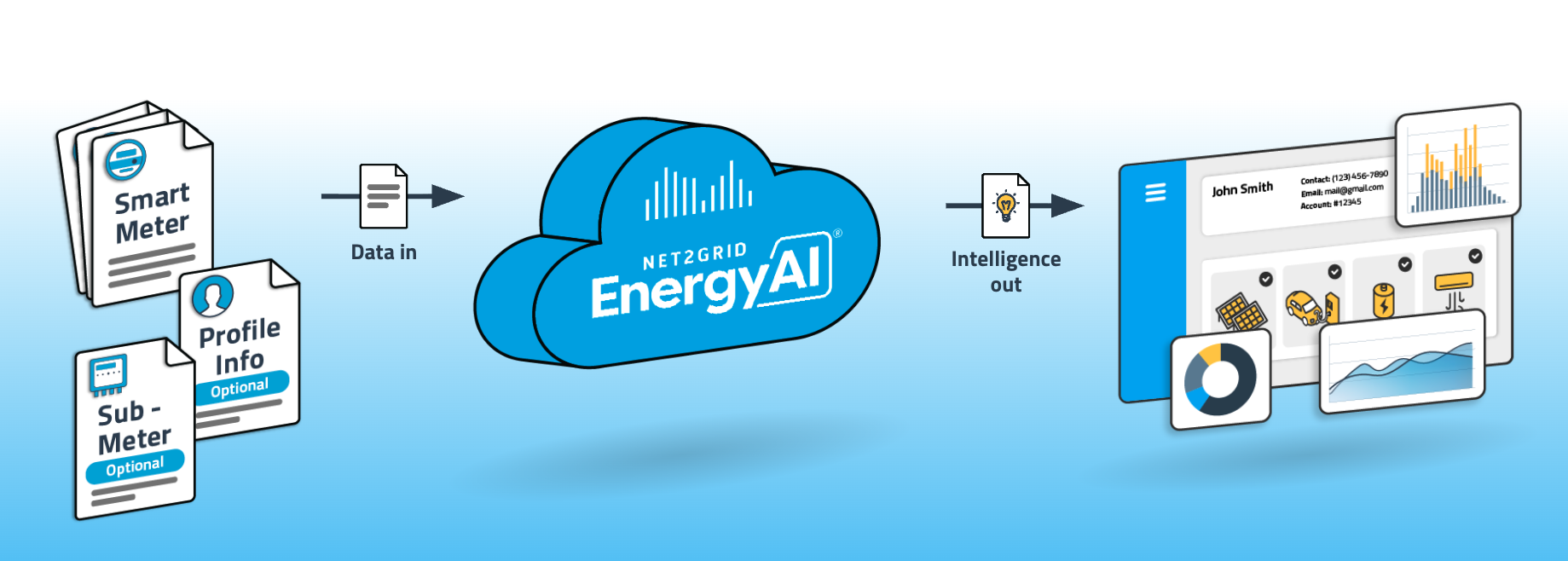
The NET2GRID EnergyAI® Cloud operates primarily in a file-based manner, where both the input and output processes are managed through structured files exchanged via AWS S3. The service utilizes advanced machine learning and time series analysis to break down residential energy usage into distinct appliance categories.
NET2GRID EnergyAI® Cloud Architecture
### Label Partners
NET2GRID EnergyAI® Cloud supports Label Partners: a group level within your account used to manage the service separately for different labels, subsidiaries, or countries. Each Label Partner operates under a single delivery configuration and can be configured on its own terms, for example its own default profile fallback values, billing-cycle-aligned reporting, or specific feature toggles.
***
## Intelligence Engine: Advanced, Evolving, and Ground-Truth Tested
Accurate energy disaggregation requires more than just basic math, it requires a deep, continuous understanding of how real-world households consume energy. The NET2GRID EnergyAI® engine is built on a foundation of multi-layered intelligence, dynamic personalization, and a massive proprietary dataset of real-world appliance behavior.
Here is a look under the hood at the technology that powers our insights.
***
### 1. Advanced, Multi-Layer AI Architecture
Our disaggregation engine is built on a modular, multi-model architecture. Rather than relying on a single, generic algorithmic model to parse an entire household's energy footprint, we utilize a layered intelligence approach optimized specifically per asset type.
* **Category-Specific Machine Learning:** Each energy category (e.g., EV charging, space heating, cooling) is powered by its own specialized machine learning model, trained to recognize the unique temporal patterns and electrical signatures of that specific appliance type.
* **Temporal Pattern Recognition:** The models look beyond simple spikes in energy; they analyze the duration, frequency, and time-of-day characteristics to accurately classify loads.
* **Robust Scalability:** The architecture is designed to operate seamlessly at scale, providing highly reliable performance across millions of smart meters and highly diverse household types.
***
### 2. Dynamic Models that Evolve Over Time
Energy behavior is not static. Households change their habits, appliance ownership evolves, and devices age and experience operational drift. Furthermore, the technology landscape is constantly shifting, new generations of EVs hit the market, charging speeds increase, solar PV systems expand, and heat pump adoption accelerates.
Because of this constant change, **static models degrade over time**. To combat this, NET2GRID's models are highly personalized, continuously validated against fresh ground truth, and updated regularly:
* **Personalized Machine Learning:** The AI learns each specific home's unique energy patterns, tailoring its detection capabilities to the actual physical reality of that household.
* **Monthly Model Updates:** Models are continuously retrained and updated on a monthly basis to reflect new behavioral habits, changes in the home, and shifting seasonal loads (like winter heating vs. summer cooling).
* **Regional Adaptation:** Energy usage patterns differ significantly across the globe. Our models are localized per market, adjusting for regional climates, local appliance mixes, and cultural energy habits.
***
### 3. The Advantage: A Decade of Ground Truth
The greatest challenge in machine learning is the quality of the training data. The NET2GRID EnergyAI® models are built on **more than 10 years of continuously collected, appliance-level ground truth data.** This is not synthetic data generated in a lab. It is lived, measured, validated reality. Building this dataset required a massive, long-term strategic investment in equipment, expert labeling, and continuous monitoring. It is highly robust and incredibly difficult to replicate.
Our proprietary training dataset includes:
* **Sub-metered appliances** across thousands of real, diverse households.
* **Millions of verified operating cycles** capturing real-world device drift and aging.
* **EV charging sessions** spanning multiple vehicle makes and charger types.
* **Solar production curves** across various system sizes and weather conditions.
* **Heating and cooling systems** operating across diverse global climates and seasons.
{% hint style="info" %}
**The Result:** Because our models are trained on real-world variability rather than perfect laboratory conditions, NET2GRID EnergyAI® delivers robust detection across different appliance generations, changing consumer habits, and unpredictable environmental conditions.
{% endhint %}
---
# Agent Instructions
This documentation is published with GitBook. GitBook is the documentation platform designed so that both humans and AI agents can read, navigate, and reason over technical content effectively. Learn more at gitbook.com.
## Querying This Documentation
If you need additional information that is not directly available in this page, you can query the documentation dynamically by asking a question.
Perform an HTTP GET request on the current page URL with the `ask` query parameter, and the optional `goal` query parameter:
```
GET https://docs.net2grid.com/net2grid-energy-ai-cloud/overview/how-energyai-cloud-works.md?ask=&goal=
```
`ask` is the immediate question: it should be specific, self-contained, and written in natural language.
`goal` is optional and describes the broader end goal you are ultimately trying to accomplish on behalf of the user. GitBook uses it to tailor the answer towards what is most useful for that goal.
The response will contain a direct answer to the question and relevant excerpts and sources from the documentation.
Use this mechanism when the answer is not explicitly present in the current page, you need clarification or additional context, or you want to retrieve related documentation sections.