> For the complete documentation index, see [llms.txt](https://docs.net2grid.com/llms.txt). Markdown versions of documentation pages are available by appending `.md` to page URLs; this page is available as [Markdown](https://docs.net2grid.com/net2grid-energy-ai-cloud/functionality/disaggregation-categories.md).
# Disaggregation Categories
## Categorizing Consumption
NET2GRID EnergyAI® transforms raw smart-meter data into meaningful, category-level insights by breaking down total household electricity consumption into specific end-uses and daily activities.
We provide structured visibility across all major residential consumption categories. Each category is modeled independently and optimized to capture real operational behavior.
***
## Supported Categories
### Major Energy Assets
#### Space Heating
One of the most consuming activities in a household, especially during winter months. This includes heat pumps, whose household penetration has been rising steadily due to their efficiency.
> *The Space Heating category is also supported in gas disaggregation.*
#### Space Cooling
One of the most energy-intensive activities in regions with hot summers. Air conditioning units are the most common cooling appliances, though heat pumps are also frequently used for this purpose.
#### Electric Vehicle
While overall market penetration is still growing, an EV fundamentally changes a household's load. When present, EV charging becomes a massive proportion of monthly energy consumption, often reaching 40–50% of the total.
{% hint style="info" %}
[Check how NET2GRID EnergyAI® sees EVs at the charging event level.](/net2grid-energy-ai-cloud/functionality/electric-vehicle-charging-events.md)
{% endhint %}
#### Water Heating
Represents the electricity used to produce hot water within a household. Typical appliances include electric showers, immersion heaters, and water pump boilers.
> *The Water Heating category is also supported in gas disaggregation.*
#### Swimming Pools and Saunas
Specialized appliances with low overall penetration but high energy impact. Pools are more common in warmer climates, while saunas are prevalent in colder regions. When present, they can contribute 20–30% of a household's monthly electricity use.
***
### Daily Activities & Baseline
#### Always On
Refers to the standby energy consumption of appliances constantly plugged in. Even though individual standby consumption is trivial, their daily aggregated use can make up a significant portion of the household's total consumption.
#### Refrigeration
Includes fridges and freezers that operate continuously throughout the day and night, meaning this category's overall consumption is substantial.
#### Lighting
Comprises all illumination-related appliances in a household. Consumption is generally low for residential users, with usage primarily occurring during evening and night hours.
#### Entertainment
Covers a large variety of primarily non-energy-intensive devices used for leisure or education, such as TVs, game consoles, and computers.
#### Laundry
Includes appliances used for washing and drying, such as dishwashers, washing machines, and dryers. Usage typically depends on the number of tenants, and their scheduling capabilities often allow operation during night or early morning hours for cost reduction.
#### Cooking
Covers essential appliances necessary to prepare daily meals, such as ovens and hobs, alongside frequent micro-appliances like toasters, coffee makers, and microwaves.
> *The Cooking category is also supported in gas disaggregation.*
#### Other
Groups all remaining appliances that do not fit into the categories above. The completeness of the household profile plays a significant role in minimizing this category.
***
## Solar PV Generation
In addition to categorizing consumption, NET2GRID EnergyAI® detects and quantifies behind-the-meter Solar PV production.
A standard smart meter only measures the net energy imported from or exported to the grid, leaving the home's *true* gross load and total solar generation hidden. NET2GRID EnergyAI® reconstructs this complete energy balance. By calculating exact solar production, self-consumption, and true total load, we prevent distorted consumption patterns and ensure that every appliance's energy use is accurately classified, even when the home is self-generating power.
{% hint style="success" %}
[Learn more about how NET2GRID EnergyAI® models Solar PV generation.](/net2grid-energy-ai-cloud/functionality/solar-production.md)
{% endhint %}
***
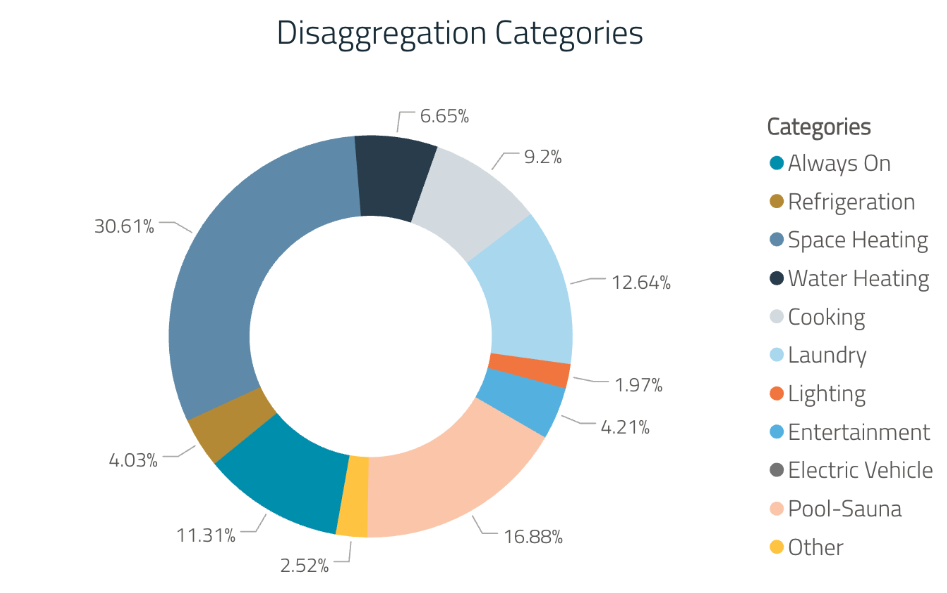
## How does disaggregation look like in a household?
The following figure shows an example of how energy was used in March 2025 for a specific consumer.
Example of disaggregation
***
## How we deliver this
The disaggregated data is compiled into a clear, structured consumption breakdown, ready to be utilized in your reporting workflows or integrated directly into your consumer experiences.
Disaggregation Categories are available in the [Monthly - Home Energy Reports](/net2grid-energy-ai-cloud/delivery-configurations/monthly-home-energy-reports.md) and [Daily - Consumer Intelligence](/net2grid-energy-ai-cloud/delivery-configurations/daily-consumer-intelligence.md) delivery configurations, where you'll also find the link to the interface specifications.
---
# Agent Instructions
This documentation is published with GitBook. GitBook is the documentation platform designed so that both humans and AI agents can read, navigate, and reason over technical content effectively. Learn more at gitbook.com.
## Querying This Documentation
If you need additional information that is not directly available in this page, you can query the documentation dynamically by asking a question.
Perform an HTTP GET request on the current page URL with the `ask` query parameter, and the optional `goal` query parameter:
```
GET https://docs.net2grid.com/net2grid-energy-ai-cloud/functionality/disaggregation-categories.md?ask=&goal=
```
`ask` is the immediate question: it should be specific, self-contained, and written in natural language.
`goal` is optional and describes the broader end goal you are ultimately trying to accomplish on behalf of the user. GitBook uses it to tailor the answer towards what is most useful for that goal.
The response will contain a direct answer to the question and relevant excerpts and sources from the documentation.
Use this mechanism when the answer is not explicitly present in the current page, you need clarification or additional context, or you want to retrieve related documentation sections.